
We've just finished editing some video and photos from the Caledonian Canal so here's the link -it's a 10-minute film, hope you enjoy it:
We've just finished editing some video and photos from the Caledonian Canal so here's the link -it's a 10-minute film, hope you enjoy it:
We're back home and struggling a little with the combined effects of Covid and the hot weather. The lawns are parched brown and the ground is rock hard.
 |
| The village church with the graveyard parched brown |
 |
| Looking south past the house - it'll be a good harvest for grain, at least. |
Here's the link: https://youtu.be/MO9MnKTLmcI

The final 258nm passage back to Dartmouth was fast and eventful - we completed it in 39 hours. A perfect beam reach across the Irish Sea saw us pass north of the Isles of Scilly at 09.00 on Saturday and we then turned to port, hoisted the Parasailor and had a great day's run east, passing very close to Wolf Rock lighthouse, south of Land's End.

We decided that it would be safest to wait till first light to drop the sail and Constance our amazing autopilot did an excellent job to keep us on course. However, sailing much faster than planned, we arrived at the tidal gate of Start Point about 2 hours too early and had to fight a 2-3 knot adverse current which also built up the seas. It would have been much more sensible to be under more easily-controlled white sails, with the option to heave-to (effectively parking the boat with the sails opposing each other) to wait for the tide. Ah, well, we never stop learning, and that experience is salted away as reference for future passages!
Anyway, by 07.00 on Sunday we were safely back on our home mooring and retired to our bunks for a few hours.
On Monday morning Graham, still testing negative but feeling tired with the onset of a head cold, masked up as a precaution, took the train back to Taunton. In a completely full carriage of 92 seats he was the only person wearing a mask which goes a long way to explaining the recent peak of the Ba5 variant; roughly 1 in 17 people in England are currently infected, according to the Zoe Covid Survey, so statistically you'd expect 5 people in that carriage to be positive. Anyway, a taxi ride completed the journey back to Kilve to collect the car, which started first time (we love that Subaru!). By the time he got back to Dartmouth, though, he was feeling distinctly ropey so took another test.

 |
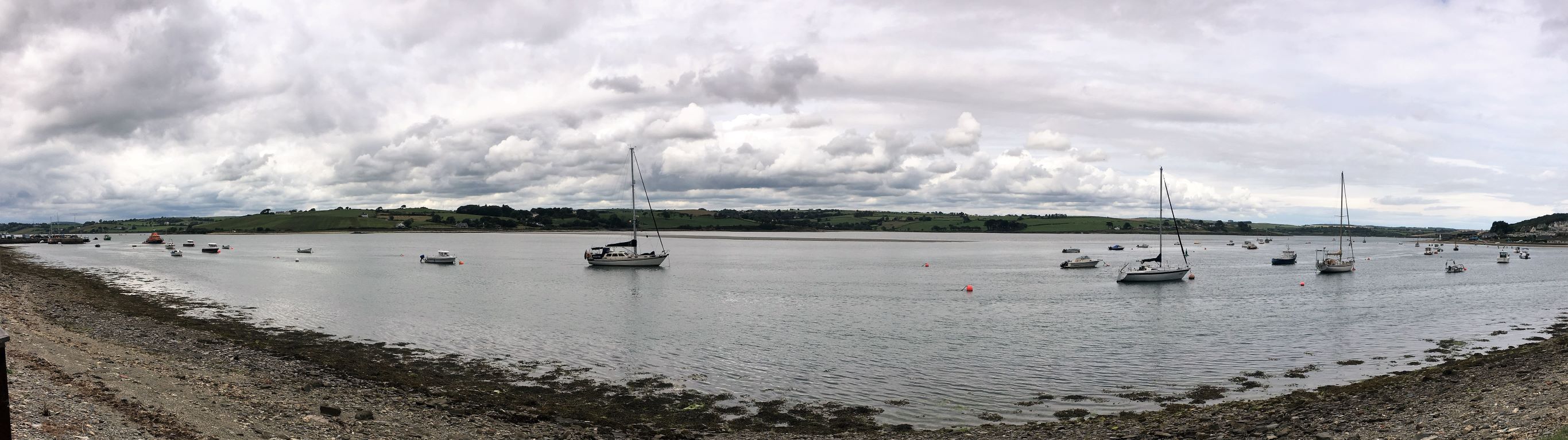
A quick update from our isolation anchorage at Courtmacsherry (or Courtmac, as we locals call it). We've had calm weather and, this morning, a beautiful sunrise and we've had time to rest and recover over the past three days.
 |
| Maunie's new home |
 |
| The anchorage at low tide, looking towards the mouth of the estuary |
 |
| Sunrise this morning |
 |
| The yacht heeling over as the water drains away |
Dianne has been feeling pretty groggy but has managed to catch up on sleep so is feeling a lot better, though she's certainly not fully recovered yet. Graham, somehow, is still testing negative for Covid so his being banished to the aft cabin seems to have worked so far.
So we've decided that we'll set off this afternoon for a 40-hour passage to Dartmouth. Di's well enough to keep watch though isn't up to anything too strenuous. Thankfully, the weather looks as good as it's going to get for us - the shipping forecast gives the wind as SW Force 3-5 (which means we'll be reaching, the fastest and most comfortable point of sail) and the sea state is mainly slight.
Departing Courtmac at 15.00 today, we should reach Land's End around 18.00 tomorrow and, hopefully, a large blue spinnaker will be involved!


 |
| Old Head of Kinsale lighthouse |


Our time in Howth, waiting for the wind direction to change to a more friendly direction, gave us the opportunity to take the 30-minute DART train into Dublin for a day's sight-seeing. Unfortunately we picked the hottest day in Dublin for 135 years (33.2 degrees C) so a rain-starved city with no shortage of bars but, apparently, not enough toilets smelled chiefly of impatience. There was a lot of litter around, too, and the streets were full of foreign tourists - which included ourselves, we suppose. Anyway, despite this, we enjoyed walking through Trinity College, found a great cafe away from the tourist hot spots for a light lunch, had the obligatory overpriced pint of Guinness in Temple Bar and climbed aboard the Jeanie Johnston.

On average, the length of the transatlantic journey was 47 days. The most passengers she ever carried was 254, from Tralee to Quebec on 17 April 1852. To put this number in perspective, the replica ship is only licensed to carry 40 people including crew.
Despite the number of passengers, and the long voyage, no crew or passenger lives were ever lost on board the Jeanie Johnston. This is generally attributed to the captain, James Attridge, not overloading the ship, and the presence of a qualified doctor, Richard Blennerhassett, on board for the passengers."
The replica was commissioned in the 1990's and was designed to meet all the latest safety standards, including watertight bulkheads, fire suppression systems and high-tech engines and generators, but the complex project was dogged by delays and overspends. The original cost had been projected at £4.26m sterling (~€5.8m) in 1993 and the final cost was just under 14 million Euro in 2002, funded by the Government, the EU and various sponsors. The final figure included the seagoing ship, shipyard, workshops and visitor centre at Blennerville, cost of launch, fit out at Fenit and the cost of training in shipbuilding skills to some 50 unemployed young people.
Her life as a working sail training vessel was very short and by mid-2010 the decision was made to operate the ship as a museum on the river because she was no longer in seagoing condition. In 2011, significant water damage was discovered, but repair work wasn't carried out until three years later due to lack of funding to dry dock the vessel.
According to a valuation obtained by Kerry County Council in 2002, the Jeanie was then worth 1.27 million Euro. In 2015, she was valued at 150,000 Euro, a pretty spectacular rate of depreciation! The tour was interesting, to learn some of the history of the Famine exodus, but it was really sad to see the beautifully built replica slowly falling apart due to lack of funding.
 |
| Di at the helm. Note the woodwork crying out for new varnish |

Arklow was lovely except for two, related, issues. First, there's a huge, 140-million euro project underway to build a new sewage processing plant for the town so the place reverberated to the sound of pile-driving and drilling. Second, and the reason for the project, is that raw sewage is currently just released into the river, with one of the out-falls being just a few metres from our pontoon berth. After days of no rain here, the river flow was very slow so the place just stank. Such a shame as the town itself was quite attractive and the Harbour Master very friendly and welcoming. However, until the sewage works is completed (In September 2025!) you don't so much berth in Arklow, as go through the motions. Another early start the following morning saw us happy to leave.

 |
| Flying the Parasailor, dead downwind, with two poles for stability in the slightly rolly sea |


Our final Irish coastal passage saw another 04.30 start to head west to Kinsale, an 81nm, 13-hour passage in very little wind so the engine ran for most of the way.

Kinsale will be our final port in Ireland and it's a great place to visit. It's a huge sailing centre and the self-styled Gourmet Capital of Ireland, so is very popular with visiting boats. Too popular, it transpired, because we discovered that all three marinas were fully booked and we were lucky to get a last-minute cancellation in Castlepark Marina. Normally we'd have happily anchored in the river but the weekend weather was forecast to be wet and windy (and the forecast has come true!).
 |
| The final approach into Kinsale |
 |
| Castlepark Marina is a 30-minute walk via the road bridge into town, but we were very glad to have its shelter |
 |
| The C17 battery of Fort James at the tip of the promontory |
The most important reason for coming to Kinsale was that our goddaughter Belle is working over here and so we had a lovely long lunch with her in town yesterday.

 |
| The wind direction looks good, we just hope that the sea state isn't too rough after a couple of days of strong winds. |
 |
| Howth Marina at Low Water |
The passage south from Islay went perfectly, though the 3.30am alarm clock call wasn't greeted with huge enthusiasm. Once we set sail, though, we had excellent beam-reaching sailing and our Orkney Tides Masterclass seems to have paid off; we picked up the fast-flowing, south-going tide off Rathlin Island and carried it all the way south.

After an overnight stop in Bangor, it was another relatively early start for the 89nm passage down to Howth, just north of Dublin. Again we had good tidal assistance but slightly fickle winds so there was a mix of sailing and motor-sailing, with about 15 dolphins coming to join us for 20 minutes on route.

We're glad to report that we made it to our marina berth, though for the last 100m the depth-sounder showed only 1.5m of water and Maunie draws 1.8m! We ploughed a neat furrow through the silt thanks to our momentum and a healthy dose of engine power. At full low-tide we could see just how silted the harbour has become:
 |
| The entrance to Howth Harbour. The old lighthouse is no longer functional but is still inhabited |
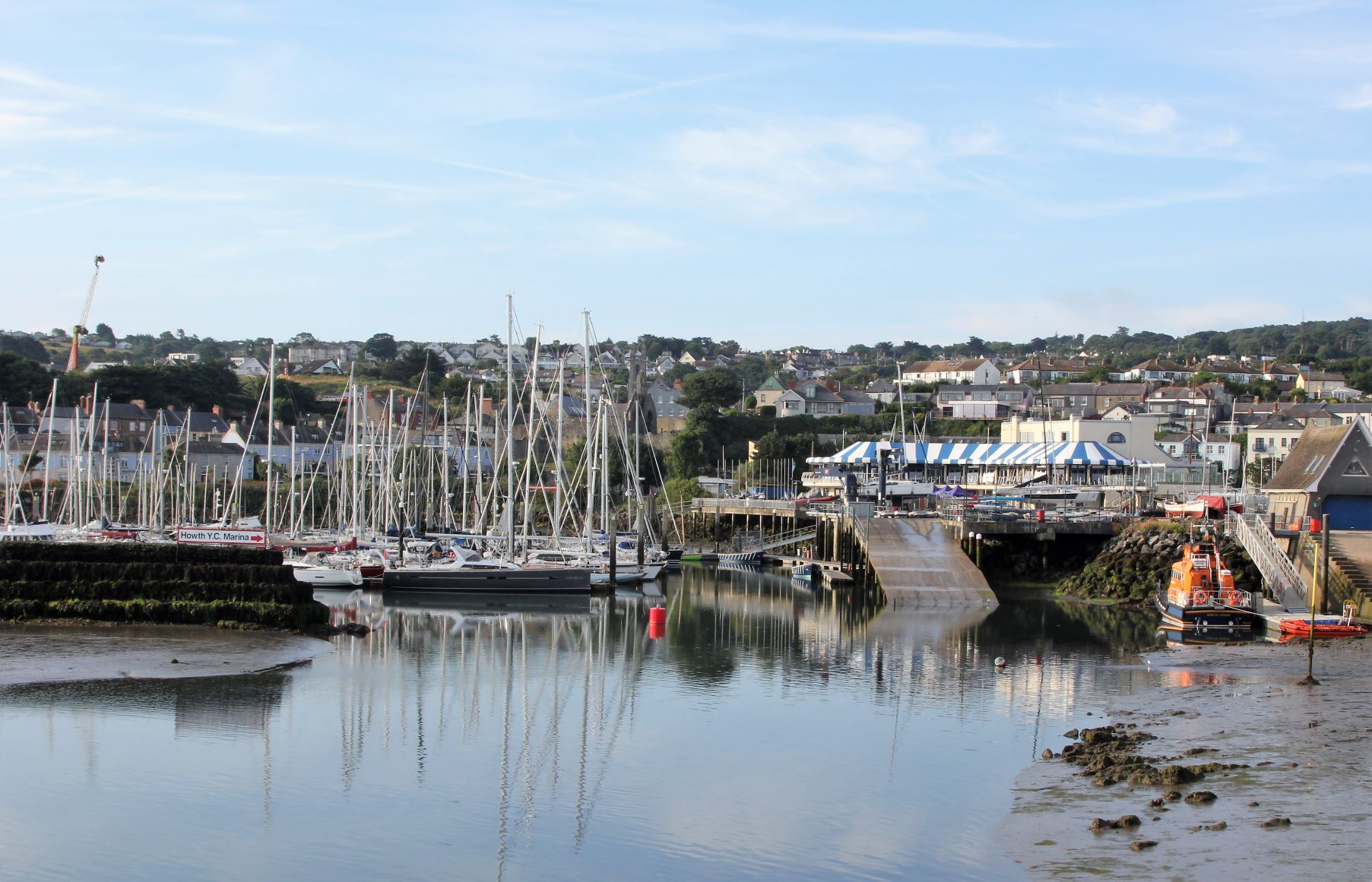 |
| The final approach to Howth marina. The Yacht Club is the blue and white roofed building |

 |
| The marina at Low Water - most of the boats have their keels stuck in the soft mud |

Talking of which, we're impatient to get moving again. The heatwave will end today with the welcome (for us) switch to northerly winds so we'll head off tomorrow morning for the little harbour in Arklow, about 40nm further south. After that we'll probably head on to Kilmore Quay, at the very SE corner of Ireland to plan the 130nm crossing to the Isles of Scilly.
