Welcome to the Maunie of Ardwall blog

This is the blog of Maunie of Ardwall. After a six-year adventure sailing from Dartmouth to Australia, we are now back in Britain.

Tuesday, 19 July 2022

Into Ireland


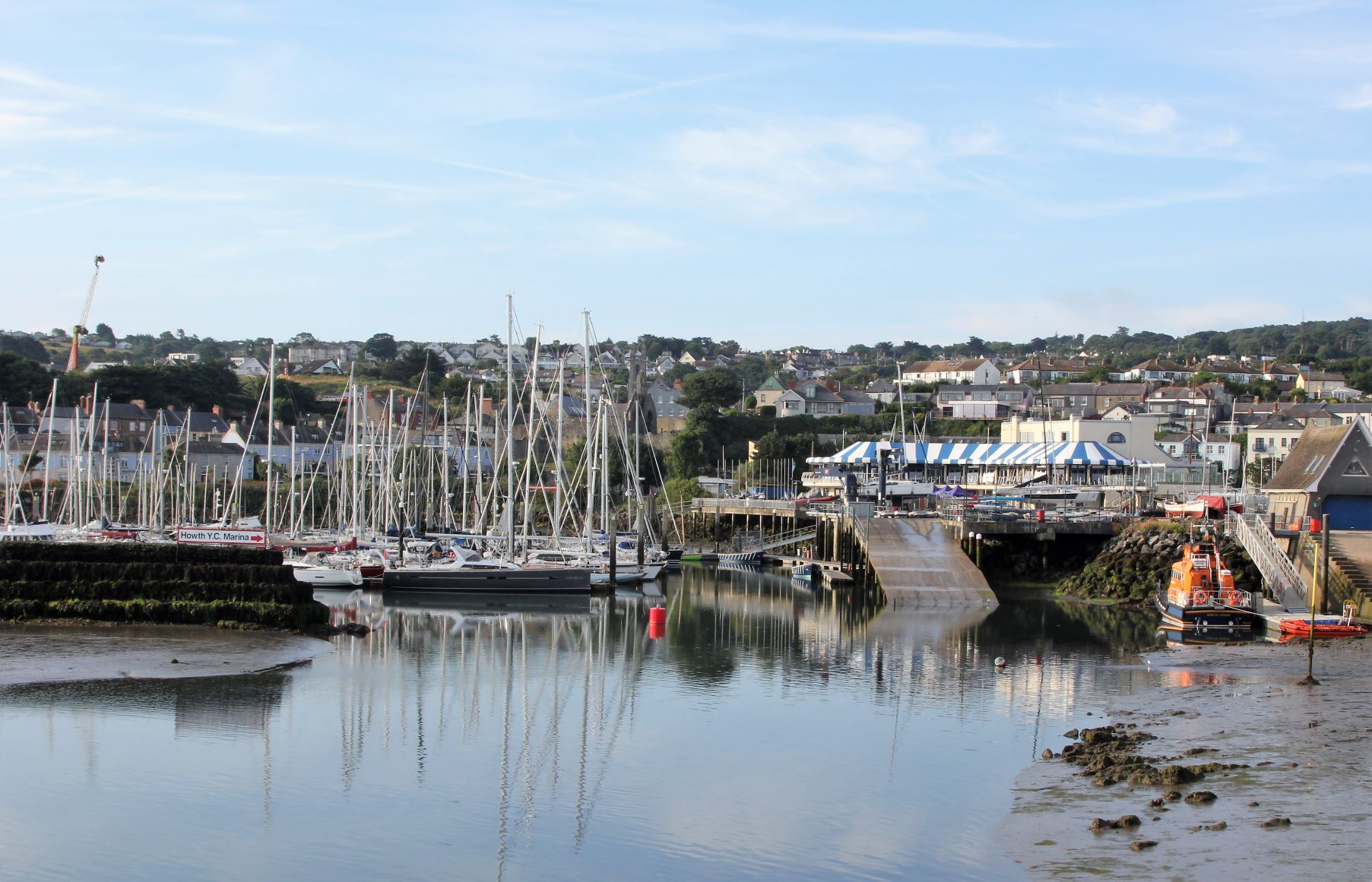
Howth Marina at Low Water

The passage south from Islay went perfectly, though the 3.30am alarm clock call wasn't greeted with huge enthusiasm. Once we set sail, though, we had excellent beam-reaching sailing and our Orkney Tides Masterclass seems to have paid off; we picked up the fast-flowing, south-going tide off Rathlin Island and carried it all the way south.


The wind began to falter as we came in to the lee of the land but we decided to continue on to Bangor, completing the 63nm passage in just over 9 hours.

After an overnight stop in Bangor, it was another relatively early start for the 89nm passage down to Howth, just north of Dublin. Again we had good tidal assistance but slightly fickle winds so there was a mix of sailing and motor-sailing, with about 15 dolphins coming to join us for 20 minutes on route.


Our 7.00pm arrival in Howth was about 90 minutes before Low Water and we called the Howth Yacht Club on the VHF for advice on water depths. The very helpful chap who responded explained that the harbour has silted up and it'd be marginal as to whether we'd get in. He advised that we should either wait at anchor for about 3 hours (for the rising tide) or else 'have a good run at it!'. The silty mud is very soft so we reckoned that the worst that could happen would be us sliding to an ignominious halt in full view of all the locals watching from the Yacht Club terrace.

We're glad to report that we made it to our marina berth, though for the last 100m the depth-sounder showed only 1.5m of water and Maunie draws 1.8m! We ploughed a neat furrow through the silt thanks to our momentum and a healthy dose of engine power. At full low-tide we could see just how silted the harbour has become:

The entrance to Howth Harbour. The old lighthouse is no longer functional but is still inhabited


The final approach to Howth marina. The Yacht Club is the blue and white roofed building


The marina at Low Water - most of the boats have their keels stuck in the soft mud

Howth is a busy fishing port but also a seaside town for Dubliners, connected to the city by a frequent 30-minute DART train service. The Yacht Club is the largest in Ireland and has a competitive racing fleet. There's a fleet of one-design wooden boats called Howth 17's which race twice a week; most of them are about 110 years old.


We've been here for a few days while the winds have blown steadily from the south and the temperatures have risen. Our trip into Dublin yesterday coincided with the hottest day recorded in 135 years - 33.1 degrees in the city - but nevertheless we enjoyed seeing the place. It was, however, crowded with foreign tourists (that category includes us, we suppose), it seemed strewn with litter and, after several days of no rain, a city with thousands of bars and not enough public toilets smelt chiefly of impatience.

Talking of which, we're impatient to get moving again. The heatwave will end today with the welcome (for us) switch to northerly winds so we'll head off tomorrow morning for the little harbour in Arklow, about 40nm further south. After that we'll probably head on to Kilmore Quay, at the very SE corner of Ireland to plan the 130nm crossing to the Isles of Scilly.

Wednesday, 13 July 2022

Completing the Scottish Loop


Craighouse, Jura. The community provides moorings (£12 per night) as kelp on the seabed can make anchoring tricky

Yesterday we arrived in Craighouse, the only village on the island of Jura. It was an 05.30 start from the anchorage in Puilladobhrain to catch the south-going tide through the Sound of Luing (where we had over four knots of current behind us, causing the water to swirl and boil impressively), we then passed the fearsome Corryvreckan, where dangerous whirlpools form, and hugged the east coast of Jura as we headed south. All of this happened in drizzle and less than 500m visibility, so it was wonderful to have the skies clear and the warm sun appear in the afternoon. 

The route down the east coast of of Jura and on to Islay


A visit ashore allowed Graham to sample some excellent Jura whisky at the distillery and we had a good pub supper in the Jura Hotel. The availability of food at the hotel wasn’t a given – like a lot of places up here, Brexit has been very bad news for the hospitality industry, with too few locals available to fill roles that used to be done by Europeans coming over to work.  At the moment the hotel can’t provide lunchtime meals and evening meals are only available five nights a week.  One can only hope that Jacob Rees-Mogg might come up here with his family on holiday to experience the reality!

The Paps of Jura in the background - they are often shrouded in cloud!


Today was another early start to gain tidal assistance for the passage down to Port Ellen on Islay. We had great sailing in gusty Force 5-6 conditions. Our arrival in Port Ellen marks a milestone for this cruise – we crossed our incoming track to complete our Scottish Loop – we’ve sailed 822nm since we were last here on the 16th of May. 

Our clockwise route in red

We’re now contemplating the crossing of the North Channel back to Northern Ireland to start picking our way down the Irish Sea. We’ll be sad to leave this amazing part of the world but yesterday’s glimpse of warm sunshine has made us realise that we’ve had really poor weather for most of the trip and we look forward to wearing the shorts and t-shirts that have remained packed in our lockers!  There’s another hideously early start (about 04.30) on the cards tomorrow to use the westerly wind and the strong tides to send us south – to Glenarm or maybe further to Bangor if we make good time.


Monday, 11 July 2022

Back to Salt Water

The canal to the left, the sea to the right

 After a week in fresh water, Maunie enjoyed the return to the salty stuff yesterday afternoon as we locked out of the Caledonian Canal and into Loch Linnhe.

Our descent of Neptune’s Staircase went very smoothly on Saturday afternoon, we’re glad to report. There wasn’t room to moor up in the Corpach Basin (the last section before the sea lock) but that suited us quite well as we had a very quiet pontoon on the Corpach Reach, just above the final locks, for Saturday night. Sunday was (at last!) warm and sunny so we had a relaxing time waiting for the next group of boats to come down the staircase so that we could join them for the final locks out to sea. Geoff, meanwhile, took a taxi into Fort William at lunchtime to catch his bus to Glasgow and then onwards to Dumfries and home. We really enjoyed his company aboard and were delighted to see him return to top form after a fairly prolonged period of illness. He says that a week on Maunie should be prescribed on the NHS!

Our final night's pontoon with Ben Nevis behind us

The Corpach Double Lock, the basin and the sea lock

The upper reaches of Loch Linnhe are shallow in places

The canal team is very short of staff at the moment so Angus, the Corpach lock keeper, had to help his colleague manage the Neptune’s Staircase operation which meant we couldn’t lock out into the sea until just after 4.00pm. However, an earlier departure would have seen us battling adverse tide, so it worked out pretty well for the 18nm passage down to a lovely anchorage called Port Ramsay at the north end of Lismore Island. 

The Swiss crew of the racy Sea Magix (an X-37) left with us and did a great job beating out of the narrow Loch Linnhe, giving us the chance to get some good action photos for them.


Maunie, on the other hand, had a dinner date to meet so we motor-sailed for best speed to anchor at Lismore just before 8.00pm. In the process we were delighted to discover that a week in fresh water, aided no doubt by the thrash to windward up Loch Ness, had killed the fine layer of furry weed that had started to adhere to the hull and propeller, so our boat speed is now restored to normal; we’d noticed it being a few tenths of a knot slower than usual as we came down from Orkney.  

Already in the anchorage were Colin and Ana in their new boat Celtic Spirit, a Rustler 36. They came over for supper on Maunie and it was wonderful to see them, albeit briefly. Family duties meant they left the anchorage early this morning to return home so we’ve missed out on cruising in company at least for this year.


We motored south in another flat calm to anchor in Puilladobhrain, arriving at 11.00am; last time we were here was a year ago with Adam & Cindi and Bravo. As predicted, a brisk southerly wind has now arrived but the anchorage is well sheltered and the holding is soft mud. We’re hoping that the breeze will reduce a little and veer to the west tomorrow to allow us to sail south.

We have about three weeks left of this cruise so, although we really don’t want to leave this beautiful part of Britain, we need to start planning the trip back down the Irish Sea. We certainly don’t want to repeat last year’s experience of motoring most of the way, so we’ll be watching for any signs of west or northwest winds to make some good progress back towards Dartmouth. The trip might involve a stop in the Republic of Ireland so we need to brush up on the post-Brexit regulations on clearing out of the UK and into Ireland. What a bloody palaver; thanks, Boris, for nothing!


Saturday, 9 July 2022

A Technical Hitch on the Caledonian Canal


Looking up Neptune's Staircase at Banavie

We are getting towards the end of our canal adventure but there's been a bit of a problem. We arrived at Banavie basin, above the 8-lock set known as Neptune's Staircase, just after lunch and had the option to join a cohort of boats locking down that afternoon.

Maunie in the foreground

Looking towards Neptune's Staircase and the sea beyond it

Thankfully, as it turned out, we decided that we'd go through the following day so had a relaxed afternoon watching the boats work down the locks.

A multi-cultural group - two Swiss, two Norwegian and a Swedish boat

The process took nearly two hours and all went very smoothly until the bottom lock. The lock gates opened, the road traffic stopped but the swing bridge decided not to swing. Alarms sounded as the hydraulic system overloaded and tripped out, leaving the boats trapped while the lock keepers tried to get the bridge to move. After about 15 minutes they managed to get the hydraulic jacks that support the roadway back into the locked position to allow cars to cross but it was clear that the boats were going nowhere, even though they were so tantalisingly close to the exit to the canal.

Looking past the road and rail bridges to the Corpach sea lock.

With the engineer having to drive up from Glasgow (and no guarantee that he'd be able to fix the fault quickly), the lock keepers told the crews that unfortunately they would have to go back the way they had come. Apparently it's not safe to leave boats in the lock chambers overnight due to the turbulent water that has to flow through them continuously when not in use. Meanwhile the keepers had to juggle with the sluice gates as the delayed exit meant that water started to pour over the top of the lock gate above the boats.


So the poor yachts had to reverse up, lock by lock, at a much slower pace - the incoming water buffeted the rudders of the upstream boats so the sluices had to be opened an inch at a time. It took almost four hours to get back to the upper canal. The crews were remarkably good humoured about it all and the lock keepers did a great job, so there was no damage to the yachts.

The good news is that the bridge has now been repaired so boats will be able to move today. We'll wait to see what that means for our own timings to head west to return to salt water.


Thursday, 7 July 2022

Leaving Orkney and Searching for Nessie


Sunrise over Loch Ness

Our trip across the fearsome Pentland Firth, where peak tides create fierce white-water standing waves that threaten the safety of even large vessels at the wrong time, was perfectly calm. The anchorage in East Weddel Sound, next to one of the Churchill Barriers, allowed us to reach the southern tip of South Ronaldsay, 11nm away, at the optimum moment.

Our final Orkney anchorage - with the wreck of a blockship beside the Churchill Barrier

The complete absence of wind meant that, apart from a little left-over swell, the 30nm passage to Wick was an easy motor and the approach to Wick Harbour, which can be tricky in strong SE winds, was a doddle. 

The route back (in pink) to the mainland

We rather liked Wick for its industrial history and architecture, although the town centre is pretty impoverished, with lots of empty shops and a faintly depressed air.

The middle and inner harbours of Wick, with the little marina to the left

The harbour in rather busier times, with a huge fleet of herring drifters

In the heyday of the herring fishing boom, the massive harbour was built by Thomas Telford (who was also responsible for the design of the Caledonian Canal) and a new settlement called Pultneytown was commissioned by Sir William Pultney to both service the increasing fishing fleet and to provide jobs and good accommodation for Gaels evicted from the land during the Highland Clearances in the late 18th and early 19th centuries. Sir William’s legacy is an impressive set of buildings, some of which are sadly in need of restoration.

Interesting building in need of a new purpose

Managers' houses...

... and workers' cottages


Wick’s fishing boom and the 1980’s oil boom are distant memories but there’s a new industry in town that’s creating some C21 jobs; a huge offshore wind farm is being extended, so vast supply vessels are based in Wick harbour to support it.

Our onward passage from Wick to Inverness had to be re-planned slightly. The calm weather that finally followed a long period of strong winds had suddenly encouraged an armada of yachts to head towards the Caledonian Canal so it transpired that Inverness Marina was fully booked. We therefore decided to make the 70mn coastal passage to an overnight anchorage in Cromarty Firth and took a break from the motoring (no wind at all) to investigate the little harbour of Helmsdale.

The straight-line track of motoring along the coast, with a stop at Helmsdale.
Note the windfarm to the SE of Wick

Helmsdale from the land - the little man-made harbour requires a bit of a handbrake turn to enter and you need to arrive near high tide to clear the shoals

We would have liked to stay a night but the visitor's berth where we moored only has about 1.1m depth of water at low tide and we need 1.8m!

An RNLI fundraising tableau on the dockside...

.... Dianne met Gary, its creator, He put it together as a lockdown project and encourages visitors to make a donation. So far he's raised over £14,000!

The view in Cromarty Firth. A yard that previously built and serviced oil rigs is now assembling the foundations for wind turbines


On Sunday we made the final move round to Inverness and the entrance to the Caledonian Canal. It was a cracking sail in a pretty brisk wind, so we were glad to reach the calm water of the Clachnaharry Sea Lock.

The final beat into Inverness, under the impressive Kessock road bridge.
The Clachnaharry sea lock is to the bottom left of the chart


The sea lock. Maunie shares it with two Norwegian and one Dutch boat.
We've been surprised to find that British yachts are outnumbered by European ones on the canal

Graham’s dad, Geoff, joined us in Inverness for the Canal transit and, so far (three days in), we’ve had a great time in some mixed weather. The initial Muirtown staircase of four locks took us into a tranquil section; the canal doesn't leave the River Ness very far away:

A lunch stop at Dochgarroch lock, with the river to the right

Looking SW from Dochgarroch towards Loch Ness

The visitor pontoons and shore toilets / showers are excellent

Day 1 on Loch Ness and Geoff enjoys some lovely sailing

An overnight stop near the imposing Urquhart Castle on the north side of the loch


The Force 6-7 on the nose in the second half of Loch Ness the following morning  came as a bit of a surprise!

Motor-sailing against the fierce wind and choppy water

38 short tacks up to Fort Augustus at the SW end of the loch

This morning, by contrast, we had calm sunshine as we prepared to leave Fort Augustus to climb its staircase of five locks.

Looking towards the Fort Augustus locks

The large Victorian building to the left was a monastery and is now a hotel

Early morning in Fort Augustus before the crowds of tourists arrive.
The locks are left full overnight in case anyone tumbles in after overdoing things at the Lock Inn!


These locks were followed by another single lock to head into Loch Oich which is the summit of the Canal system. From there we have motored through the very leafy Laggan Avenue section to moor up just before the two Laggan locks which are the first down-hill chambers of the route.

Tomorrow we’ll pass through these, cross Loch Lochy and head down towards Fort William. We’ll be hoping that the cloud lifts to give a view of Ben Nevis as we go.