When we first sailed in these waters, a year ago, we were in a bit of a hurry to get south to Sydney so we did some long, overnight passages to cover the miles quickly. This year we decided to try to cover it in more relaxed and manageable day-sail chunks, partly for comfort, partly to see the coastline and partly because of the weather. We chatted to a semi-retired professional fisherman the other day and he told us that the weather patterns are becoming increasingly unusual (how many times have we been told that on our voyage?); the normal summer north-easterlies haven't become established yet this season and the south-going East Australia Current is much closer inshore than normal. We've certainly experienced some very light winds, which tend to die away to nothing at night (another reason not to do overnight sails) so we've spent time in some interesting places waiting for wind. Port Macquarie was one such spot. A thriving holiday town on the mouth of the Hastings River, Port, as it's known, has a little marina which allowed us to replenish water, fuel and food but we really enjoyed the quiet anchorage up the river.
A photo of our chart-plotter - Port Macquarie is at the bottom of the picture and Maunie's river anchorage is top-left.
We were surprised to see this 125ft dredger being towed up river past our anchorage. There's quite a substantial shipyard upstream.
We left Port on Monday for the 35nm passage down to Crowdy Head, a tiny man-made harbour that interested us when we first read about it. Captain Cook first sailed past the place on the 11th May 1770 and, depending on which story you prefer, named it either because he saw a large crowd of Aborigines watching the Endeavour from the headland or because he had a crew-member called Charles Crowdy. The bay had a reef projecting northwards from the point so it was used by early European settlers as a relatively safe anchorage but the modern harbour was completed in only 1972.
Our pilot book, published in 2010, warned that there is often a swell surge in the harbour and that the long visitors' pier (visible in the middle of the harbour in the photo above) could be uncomfortable to moor against. However it said that it was sometimes possible to contact the Fishermen's Co-op to secure a berth on the busy fishing boat jetty on the east side. In seven years, all has changed, we discovered. The fishing fleet (once around 30 trawlers) has gone, the visitors' pier has been condemned as unsafe and the whole place was almost deserted, with just a few holiday homes occupied. The helpful radio operator at the local Marine Rescue centre told us we could moor alongside the new unloading dock (pretty much the only sign of recent investment) and we spent three very comfortable days there, waiting for wind, doing boat jobs and exploring.
The Crowdy Head harbour. Abandoned fisheries co-op to the left, old pier in the middle and practically-empty fishing boat pier to the right
Calm water in the harbour, with just one catamaran for company
The cute Crowdy Head lighthouse, built in 1872
The view down to the harbour
Maunie on the new wharf with expensive holiday homes behind
It was hot in the still air - up to 32 degrees - so Maunie sported her full complement of sunshades.
Sunset with some rain in those clouds
A present from a local fisherman - two delicious Red Snapper
On Thursday the NE wind finally began to show signs of turning up and we had a lovely 77nm sail south to Port Stephens, a huge natural inlet that's bigger than Sydney Harbour but which has no industrial settlements, just a few little holiday towns. The Parasailor flew for about six hours and we picked up a free visitors' mooring in Salamander Bay just before dusk.
Heading into the sunset
Salamander Bay is handy for a big shopping mall so, since there were no shops at Crowdy Head, we did a quick supermarket run then sailed across, in a fairly brisk 23 knot NE, to the wonderfully calm Fame Cove.
We only tow the dinghy in flat water as we have heard too many horror stories of them flipping over in big waves.
Even in such tiny coves, there is a good sailing social life to be had. We went aboard the German HR35 'Lucie' whose owners Michael and Annick we met in the Boat Works when their boat was hauled out next to us. It turned out to be Michael's birthday so we joined them for cake, sparkling wine and a good laugh with more German friends. There are lots of anchorages to explore in Port Stephens but we are watching the weather with interest. The big high pressure, mentioned in the last update, has stored up a lot of heat inland and further south and there are warnings of big thunderstorms and flooding in the state of Victoria (south of New South Wales) and the lower regions of NSW so we don't know how that might influence the timing of our plans to get to Lake Macquarie and then on to Pittwater.
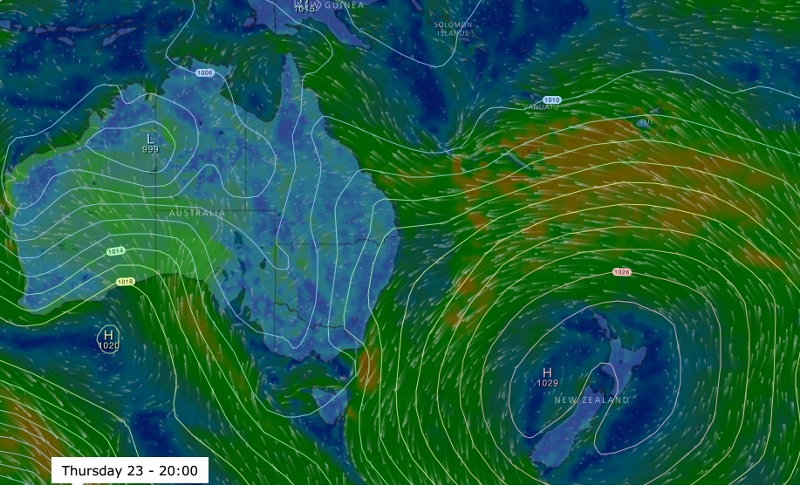
In spite of its title, this blog update isn't about us battling gale force winds as we head south; the weather has been quite the reverse, in fact. A huge high pressure system has been almost stationary over the east coast of Australia and is now only moving slowly eastwards across New Zealand.
This has given us light and not very useful SE breezes for a few days and so we've stopped for a few days at Iluka, at the mouth of the mighty Clarence River. It's here that we have taken an interest in the huge works that man has undertaken to try to manage the elements when the weather isn't so unusually settled. This image of the entrance to the Clarence River clearly shows the way in which the river has been managed, since the early 1800's, to try to make it a safe, navigable waterway. Of course, until the first quarter of the 20th Century, road and rail links along this coast were pretty sparse so the ability to allow coasting vessels to make port safely was vital to the growth of the region.
The 'training walls' inside the entrance re-directed the river from its original meander at the bottom of the picture and the long breakwaters projecting out to sea were completed in the 1970's. Work camps, temporary railways, huge cranes and rock-carrying barges were all part of the story and it's still in progress; repairs to the breakwaters are ongoing and there is a grass-seeding program underway to stabilise the sand dunes
We took a walk out to the end of the northern breakwater on a fairly gentle day:
Thousands of tonnes of rock, to be regularly maintained after winter storms
In between the breakwaters, you can still get sizeable, breaking waves so it's vital to exit or enter at the right stage of tide
Like nearly all the rivers on this coast, it has a 'bar entrance' which means that silt carried down the river is dumped, as the flow rate slows, at the entrance to leave a shallow bar. It's visible in the top photo as a crescent shape but is much more obvious in this photo, taken when the river was ebbing:
The bar at a dangerous time
So the golden rule is to always arrive at the entrance when the tide is flooding inwards and not rushing outwards to meet the incoming wind and swell. Of course, sometimes even the professionals get it wrong!
Whilst we were waiting for the weather, we managed a few walks, some chores and even a session in a gym with a great view:
Lots of Australian parks have these brilliant kits so we use them whenever we can
We moved south again yesterday, a 60nm passage to Coffs Harbour - motor-sailing the whole way, unfortunately, due to the light wind but the trip was enlivened by ships making their way up to Brisbane, fishing boats, dolphins and quite the wettest rain squall we've experienced for quite a while. Coffs Harbour is another example of an artificial harbour, built in the 1920's, but this one isn't on a river so for once we didn't have to do the maths on tide times to arrive safely at a bar entrance.
The breakwater was built to join up to Muttonbird Island in the foreground. The Marina came a lot later.
You'd think that this huge structure would have made the harbour a perfectly-sheltered one but, only last June, there was a violent easterly storm which saw huge waves rolling over the top of the wall.
The marina was badly smashed, two boats were sunk with many more badly damaged and the repair work is still going on.
The crane is hoisting huge pre-cast concrete blocks onto new rocks already laid; the plan is to make the breakwater taller and wider
It was nice to come into the luxury of a walk-ashore marina, giving us the chance to enjoy long showers and to refill Maunie's water tanks. We went for a refill ourselves at the marina bar and Graham was delighted to find Thatchers Cider on tap, only to be told it had just run out...
Thatchers Cider comes from Somerset in bulk tanks and Coopers Brewery (another family-owned business, based in Adelaide) fills it into kegs and delivers it.
We have managed to put that disappointment behind us and today have moved another 35 miles to Trial Bay, to discover a harbour where, for the moment, man has given up the struggle to beat the elements.
At the point are the remains of Trial Bay Gaol, built to house low-risk prisoners in 1886. Their job was to build a huge, 1500m breakwater from the aptly-named Laggers Point to create a safe anchorage in the bay. The project overran in time and cost and, even as the first 300m of rock wall was built, the waters behind it began to silt up so it was abandoned. We had hoped to go into the Macleay River to the SW of the photo but apparently there hasn't been a flood to wash the river bar out for several years and now it is deemed too shallow and dangerous for most boats. So we're anchored in the bay instead and it's calm but a little bit rolly. Tomorrow we'll get the maths right to go through the bar entrance at Port Macquarie.
We're back in the sailing business! Maunie had fared really well under her covers for the past 7 months, with our great friend Brian checking on her periodically. There really wasn't any winter weather here this year so she was dry and well-aired and it didn't take us long to move back into boat life. Which means, of course, tackling a longish list of maintenance jobs. We'd booked in to the Boat Works yard for 5 days ashore to attend to the annual below-the-waterline jobs and, once again, the team there looked after us very well. The yard's reputation seems to be growing, though, as it was really busy with boats hauling out for their early-summer maintenance.
Maunie is guided towards Sid, the seventy-tonne travel-lift
In spite of 7 months of inactivity, the hull only had a light coating of slime so the Coppercoat antifouling is still doing well in its 7th year. Putting a plastic bag over the propeller while Maunie was moored up was a good move.
Teamwork and practice to avoid blasting your work-mate! 3000psi pressure washers quickly had the hull clean
The list of jobs didn't look too onerous but, of course, it's a boat so there are always surprises to deal with. The Brunton's Autoprop feathering propeller needed some extra attention to take up some slack in the bearings and we decided that our batteries, showing initial signs of losing capacity, should be replaced; last time we kept them too long and they began to fail quite dramatically in Tonga. Fitting them is quite a challenge - lots of cables to deal with!
The trick is to label each cable and take lots of photos before disconnecting!
Apart from these moments, it all went to plan and a $30 car polisher and a long day's effort in the hot sunshine resulted in a shiny hull and superstructure and saved about $400 compared to a professional polish!
Nice hat, eh? Note the reflection in the cabin top.
Once again we were able to borrow one of the courtesy cars for the full weekend and this year it wasn't the little city car but a mighty (and thirsty) 4-litre V6 pick-up (they are known as 'utes' around here).
So, as well as doing some shopping runs and dropping the old batteries off for recycling, we were able to drive an hour south to surprise Brenda, Di's aunt, for lunch. Her best friend Claire had once again arranged it so Brenda was expecting to meet some fictitious friends of Claire's when we walked in.
Claire, top left, is gaining a reputation for organising surprises!
So, on Monday afternoon, a clean, shiny and serviced Maunie returned to the water.
We're now anchored inside the man-made Sovereign Island off Paradise Point and, as we motored round the island to the anchorage, we could compare the architectural 'qualities' of the multi-million dollar houses:
Prime waterfront living for the hard-of-imagination
Not sure what the radar scanner's for but there's plenty of work for the window cleaners
This only has five bedrooms, apparently!
Italianate styling, anyone?
Looking in an estate agent's window this morning, we saw that a 485 sq m building plot on the waterfront was for sale for a mere $1.8M so we kind of understood the motives of the owner of this last example who clearly said to himself, "I'm paying for the view, so just build me a pre-fab barn and punch a few windows in it.":
Anyway it's absolutely great to be back aboard, in spite of a few sweary words this morning as we tried to pull a new VHF aerial cable through the mast. The mousing line parted at a critical moment so we had to do some hard thinking to resolve it but, thankfully, we now have a fully-functioning radio once again.
We plan to start sailing south in the morning; the weather is very settled and the sea-state is calm so we'll aim to do a long day (with a 5.00am start) to get to Ballina (some 70 miles south) by dusk.
We're back in the sunshine and 27 degrees after a good flight but a potentially disastrous car journey. The Ford Mondeo hire car for the journey from Bridgwater to Heathrow Airport looked very shiny but as soon as we hit the M5 it was clear that it wasn't quite right; the steering wheel pointed about 15 degrees to port to keep it straight. Luckily we'd already planned a pit-stop for an excellent brunch at the Yeo Valley HQ Canteen which allowed us to investigate. We were pretty shocked to find that the inside edges of both front tyres were scrubbed through to the cord and wire reinforcement:
Not many miles short of a dramatic blow-out
The hire company handled the somewhat agitated phone call extremely well, arranging a replacement car from the nearby Bristol Airport, promising a full investigation as to why the fault hadn't been spotted and refunding the full hire cost before they'd even seen the tyres for themselves. After that minor setback, the rest of the journey went remarkably well and we arrived in Brisbane on Saturday evening. Jet lag kicked in with us both waking up at 4.00am but our plans for a gentle, not-doing-much Sunday were very nicely re-written with a great lunchtime meet-up with Kerry, Adam & Cindi and Lionel & Irene who all had an awesome season of sailing in Vanuatu and New Caledonia. It was brilliant to catch up with them all and we'll see more of them over the coming months. Having left a foggy and cold London, it's great to be back in Summer sunshine.
So, after a second night in Brisbane, we'll be back aboard Maunie tomorrow. Can't wait, though our arrival will coincide with a southerly gale, just to ease us back into the world of sailing!
We're in the final few days of manic packing and house-decorating before we fly back to Australia on Friday. Graham finished work on Tuesday (on a bit of a high, having successfully presented to the Thatchers' Board the main investment project he's been working on) and we're now busy packing everything into storage and doing final painting and decorating to leave the house and garden in near-perfect order. Our efforts have been slightly delayed but very enlivened by visits from Bertie the cat, who belongs to near neighbours; he's the most affectionate moggie and stops us from working for enough time to make us enjoy the autumnal sunshine:
We've also had a weekend away in mid-Wales to return Pippi, our god-daughter's car. A lovely supper with Barbara and Steve was followed by a very enjoyable tasting (Graham will certainly miss the malt whiskies in Australia!):
Finally, we had a great Sunday lunch at the local pub with Duncan and Elisabeth, complete strangers linked only by sailing (as is often the way, these days). They have bought 'Quahog', the Vancouver 38 built straight after Maunie, and plan to sail off into blue waters next year so we spent a lovely afternoon sharing tips and enjoying hearing their plans. The aforementioned 'local pub', The Hood Arms has been a complete joy, sitting at the top of our lane. The publicans are so welcoming it will be tough to drag ourselves away. At the end of our Sunday lunch, Paul, one of the owners, came along and offered us a drink 'on the house'. Cheers to The Hood Arms and wishing them a successful and not too exhausting festive season! The next update will be from Maunie. Can't wait to be back aboard her!
G'day from a windy and distinctly chilly Somerset. It's suddenly sinking-in that, in only 26 days, we'll be back in a place where G'day is regarded as a normal greeting, so the pressure's on to finish the house jobs and start packing things away for our return to a 38ft home. Actually, we have to say that the house and garden are now looking lovely and we hope that the letting agent's optimism will be rewarded with some wonderful tenants signing on the dotted line soon. As British readers will know, it hasn't been a great summer - the weather has been 'changeable' (pretty crap actually) and the mood of the newsrooms has been overwhelmingly downbeat. The Prime Minister told us that the country needs a 'strong and stable' government back in May when she rashly thought that a snap general election would be a fine and dandy idea; she's now (at the party conference) downrated our needs to 'calm' government, prompting the question of where her team now sits on sliding scale from 'inspirational' at one end to 'dire' at the other. As we feared, the machinations of the Brexit negotiations and internal party bickering have rather taken the politicians' eyes off the ball when it comes to dealing with the pressing short and long term issues that the country faces. Anyway, enough of all that. Despite the challenges, we've enjoyed being back at home. Graham's job at Thatchers Cider has proved to be challenging but enjoyable and its scope has expanded over the months. Initially focusing on a huge investment project to build a new automated warehouse (due to begin building next May), he's now looking at all sorts of other things that have him investigating areas that are new to him. Thatchers is a great business, family-owned like Yeo Valley, that's growing very quickly thanks to very loyal existing cider drinkers and many more newcomers to the brand. A few weekends ago about 8,000 of them turned up for an open day at the cider mill (5,000 more than at the last event two years ago) so Graham returned from the day having totally lost his voice after five hours of non-stop tour-guiding around the canning plant. Here's a little video of the day:
He finishes the job on the 24th October, so the week after will be a flurry of packing and stowage! Meanwhile, Di has been very busy sorting lots of house and garden jobs so the odd weekend off has been particularly welcome for us both. We did a mini Northern Tour to catch up with both our families (and, for Graham, meeting great nieces and nephews for the first time), We also got to meet Sweep, the latest addition to Norma (Di's eldest sister) and Mick's household; too cute!
Then, last weekend, we had a visit from Colin and Ana from the yacht Ithaka. You may remember that we waved them goodbye on Christmas Day 2015 as they set sail from Auckland to Chile (an amazing 6 week voyage) and, thanks to our SSB radios we managed to chat to them almost every day of the crossing. Here's a reminder of sailing with them just before they left: CLICK HERE
Their journey was awe-inspiring and saw then sail down the coast of Chile, down to the very chilly southern tip of South America and then up to the Falklands and on to Brazil, the Cape Verde islands and back to France where Ithaka is now awaiting new adventurous owners. Actually, we're rather hoping that Colin and Ana's plans will be just as unreliable as ours and that they keep her for a few more seasons - well, there's the French coast to explore, then the Baltic and, well, after South America, Iceland would be pretty straightforward! If you're interested here's a link to their YIT blog Click here
Both yacht crews really enjoyed swapping sailing stories and photos of our respective trips; when you have so much in common, conversation never falters. We managed to get some good walking in and a proper Sunday lunch at the Hood Arms so it was a great weekend.
Colin and Ana by the dramatic cliffs of Kilve Beach, less than a mile from our house
Ana in photography mode
Her view. Not quite the white sand tropical beaches that we've become used to but pretty dramatic with layers of igneous rock and oil-bearing shale
Colin summed up the feelings that we share about how it's sometime difficult to talk about our sailing experiences, to folk who've not 'been there and done it', with a great little poem in our visitors' book. I hope he won't mind us sharing it!
They think we come from outer space,
The 'normal' folk of human race,
Little they know of GRIBs or chain,
Of bommies, kelp, cyclonic rain.
To Kilve we drove, for kindred spirit,
In Di and Graham, we find no limit.
Talk and walk and eat and drink,
and reminisce, with time to think,
Of voyages new, and thing to do.
We drive away, refreshed in mind,
Feeling less unique among mankind.
Of course, loyal blog followers like you don't fall into the 'normal folk' category! Thanks to Trish (Maunie blog super-user) for the prompt to add this post. We'll do one more UK update before we fly back to Australia but, for now, best wishes from us both.
It's odd, for once, to be on the receiving end of sailing blogs from tropical islands whilst we endure a pretty mediocre British summer so it's a case of getting a taste of our own medicine, we suppose. We are certainly missing the sailing life, such wonderful photos of Vanuatu on Bravo's blog, for example, (http://svbravo.blogspot.co.uk) are making us a a little jealous but at the same time serve to remind that it's only a couple of months before we are back aboard Maunie. Mind you, after a warm and dry start to the summer here, August's wet and often chilly weather has come as a bit of a change but it's been good for the garden as we continue to work hard to get it back under control. Didn't expect the timber from a dead apple tree that we felled to be loaded into the wood-burner so early, though!
In between the rain showers, Di has been digging for victory up at the top of the garden to re-shape an earth bank that was just full of weeds. Turned out it was full of other things as well:
The rusty remains of about five car exhaust pipes were unearthed!
After this major excavation, the bank was re-shaped and we bought lawn turf from a local grower for an instant improvement. A month of rain later and it has bedded in very nicely.
The patio umbrella in the last photo shows that the weather hasn't been all bad and, for once, the August Bank Holiday has delivered warm sunshine rather than the usual disappointing rain so we've really enjoyed a brief return of summer. BBQ's on the patio, drinks with old friends in the garden and a wonderful walk along the coast, then up to the village for a traditional Sunday roast lunch reminded us that, in the right weather, this part of Somerset is really one of the best places to be. Certainly the fruit on the trees and bushes thinks so; our apples are getting ready to pick:
.... but there are rather more arriving hourly at Graham's work:
Katy apples (the earliest variety) in the hopper at Thatchers Cider
Meanwhile the hedgerows (and, unfortunately, some of our garden borders) are full of ripening blackberries. Blackberry and apple pies ahoy!
Our circular walk took us through the ancient hamlet of East Quantoxhead, a place that hasn't changed much with time and which also provided an automotive memory-lane moment for Graham:
East Quantoxhead duckpond
Thatched cottages, all belonging to the Lutteral Estate
The first family car that Graham can remember was a Bedford Dormobile like this (though ours was red with a white stripe). It had a 3-speed, steering column mounted gearshift - known as "Three on the Tree"......
..... as opposed to "Four on the Floor" for the Morris Minor, a later and equally rust-prone Keating family vehicle.
The newly re-opened Hood Arms in Kilve - great food!
Just as with sailing, though, these moments of sunshine, relaxation and good living are interrupted by maintenance jobs, all of which turn out to be more challenging than expected. "I'll just have a go at a couple of little patches of loose paint on that wall", said Graham......