Welcome to the Maunie of Ardwall blog

This is the blog of Maunie of Ardwall. After a six-year adventure sailing from Dartmouth to Australia, we are now back in Britain.

Sunday, 16 August 2015

People and places in Fulaga

Here's a short selection of photos to give you an idea of the villages, the people and the events in Fulaga:

 Places:
The view from the church at Naividamu village, the only village to face into the lagoon

Naividamu - a collection of tin huts full of welcoming, friendly people
Kids mucking about in boats - the same the world over
 Events: The arrival of the supply ship
Mini and Lutu on the canoe, before work started on it this year, waiting for the supply ship to arrive

Everyone waiting for the supply ship - Joe offers Meri a freshly-caught fish

Tara, Qele and Lissa opening clams ready to send on the ship for sale to the next island

Bis wiring closed a container of clams to go into the supply ship's fridge

Joshua watches it all

Part-finished tanoa kava bowls for export to Suva

Unloading the boats from the supply ship, the anchorage unusually busy with yachts

Everyone lends a hand

Lutu (right) knows how to pick his load - he struggles ashore with eggs and toilet rolls!

Net, the postmaster, waves as he works through the cargo on the ship
Parties:

Birthday tea for Ma the baker (she made most of the cakes herself so it was a working birthday)

A kava session at Colin and Ana's leaving party
 Getting Dressed up for the occasion:

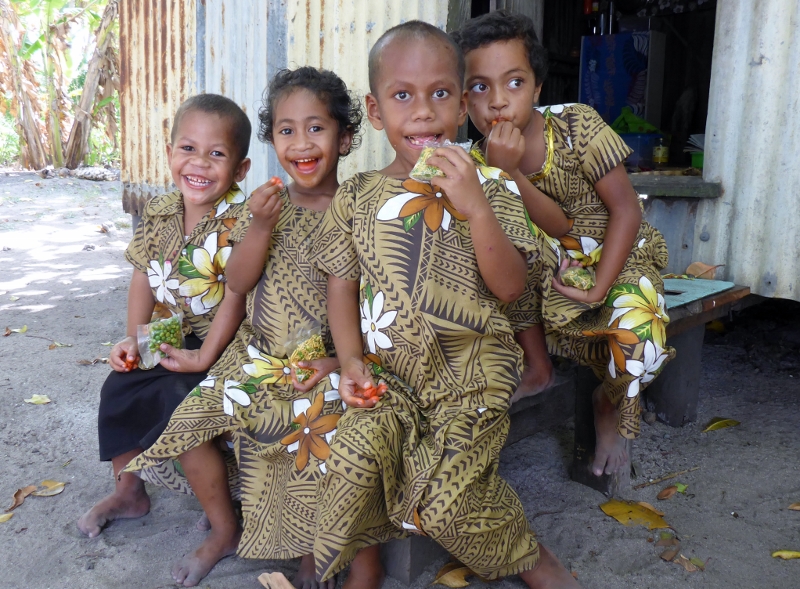
The kindergarten kids dressed up for their dance and song. Little Akosita is only 3 so is technically too young for kindergarten but there was no stopping her from attending

Enjoying dubiously-coloured sweets

Lavinia and Akosita dressed as lawyers for their part in the 'when I grow up I'm going to be' song. Akosita's hand and lips show she has already been at the sweets

Akosita in her best party frock
Dianne and the ladies at church

Tai, Moses and Bill in their Sunday best

Graham and Robbie dressed to impress at church

Views of Fulaga

Fulaga is a stunningly beautiful place and it's hard to get photos that do justice to it. This year, calm and sunny days were few and far between but we managed to get out with the camera so here are a selection of photos to give you an idea of the place:

The view east across the lagoon. The village landing anchorage is in the foreground, the sandspit anchorage is to the top right and the pass through the reef out to sea is top left

The village landing anchorage. Maunie is anchored astern of SelCitron, the yellow catamaran

One of the motus on the east side of the lagoon

Signs of ferrite in the rock

A rare moment - absolute calm at anchor


One good shove.....


Saturday, 15 August 2015

Outdoor cooking, Fijian-style: How to make a Lovo

We are back in internet land after 55 days, so have already lost hours catching up on Facebook, reading other boat blogs, checking the bank statements and so on. How did we manage without it for all that time? Remarkably easily!

Anyway the very nice people at Vodafone Fiji have decided to give us lots of bonus data so our $25Fj recharge has given us not the normal 2Gb but 12Gb to play with. It'll allow us to upload some videos to YouTube in the next few days..

In the meantime, here are a few photos to illustrate the making of a Lovo (earth oven). It's something that you could build on any beach, although unless you happen to have coral rocks and palm trees handy you might have to modify these instructions a little!

 
First dig a shallow pit in the sand, about 80cm in diameter. Keep the excavated sand piled to one side and have a pile of coral rocks (other stones would do), shavings from a newly-constructed Fijian canoe (or other kindling) and dried coconut husks (or driftwood) ready.


Start with the ancient ceremony of Passing the Bic Lighter 
Light the kindling (award yourself extra lovo points if no paper is involved)

Add the coconut husks

Add some logs and pile on the coral. Leave the fire to burn well for about an hour.

Meanwhile, prepare the food. In this case tapi solo, a dough of grated coconut and cassava, mixed with a little coconut milk and sugar. 
The tapi solo are rolled into balls and then wrapped in palm leaves like this

After an hour, rake away the logs and any other burning coconut to leave the hot stones exposed.

Place a grid of green sticks over the hot coral

Place the tapi solo on the sticks. Close supervision is important!

Cover the food with a layer of palm fronds

Add a couple of wet hessian sacks and cover them with the excavated sand. Leave for 90 minutes whilst you do some canoe-building.

Carefully scrape away the sand, remove the sacks and palm leaves and carefully pick up the hot tapi solo

The cooked tapi solo will be slightly caramelised - they are filling and tasty (about the only way we could eat cassava, to be honest)
If you manage to catch a small crab it can be cooked on the hot coral (add some of the discarded logs for additional heat if required). 
 That's all there is to it! Do let us know if you try it.

Thursday, 13 August 2015

Goodbyes said and tears shed

Our farewell to our Fulagan friends yesterday afternoon was pretty emotional but lovely. The video of the canoe was extremely well received and we learnt that the project has become a main topic of conversation amongst the men in their kava sessions; there's talk of each village building two or three canoes so that they can race them in the lagoon (the last race was back in 2000). Lutu was in tears when he talked about how much it had meant to him that we'd come back to help this year and admitted that he'd begun to think that Meli's canoe would never sail until we arrived. Wow. Such great news that the tradition looks as though it will be kept alive. Thankfully the shortage of kava in the village meant that we avoided an all-night session so we had a wonderful supper, some lovely Fijian songs (including the Goodbye Song) and, finally, hugs from all when the party wound up at about 8.00pm
 
We've postponed our departure, by a day, until tomorrow. It was partly to give us more time to get the dinghy packed away, the hull cleaned (we still aren't sure if the four Remora fish stuck to the keel are coming with us, they certainly stayed for the 2 mile passage from the other anchorage a few days ago) and some motivational choc chip cookies baked. It also gave us chance to have Carl and Linda over for coffee to share experiences of other Fijian anchorages and time to pack away the various beautiful carvings that we were given as we left the village. The wind looks a little more favourable for tomorrow as well, so we hope for a good broad reach, in around 15 knots of wind, for the 175 mile, 27 hour passage north to Taveuni; we've elected to go for the 06.30 slack water in the pass here so, even though it will be light by then, the visibility into the water will be very poor; it'll be an 'instruments departure', following our GPS arrival track. The iPad and Bad Elf GPS will be on as backup for the main chart plotter just in case of a critical-moment malfunction.

Tuesday, 11 August 2015

Things that go 'crunch'


Yesterday we reached our seventh week here in Fulaga which meant that we hadn't been to a shop for 53 days. Imagine our delight when we chatted on the SSB to a New Zealand boat called Navara in Suva a few days ago and they said they were coming to Fulaga and 'did we need anything from the market?'! Oh, yes please – anything that goes 'crunch' when you bite it!
Carl and Linda arrived yesterday and handed over 2 shopping bags of goodies (wonderful fresh greens plus butter and flour for bread and biscuit making – the little 'shop' in Fulaga had long since run out of flour – and some goodies like peanuts and crisps) so they are now, officially, our favourite cruisers. They had been here two years ago and knew Meli and Jiko well so they are delighted to see the new canoe; they have brought along an old yacht sail to cut to make something a bit more robust than the blue tarpaulin.
This afternoon we are going into the village to say our farewells, which will be quite an emotional moment we're sure. We went in yesterday to give Lutu, Bale and Mini a preview of the video of the canoe project and we have never seen such rapt concentration on anyone's faces; we'll show it to a wider audience today. The ink-jet printer has been working hard so we have dozens of 6"x4" photos to give out, plus some stunning A4 photos of the canoe under sail taken by Kerry from Sel Citron (a small version of one of these is show above).
The plan is to leave Fulaga tomorrow, Thursday, though the timings of tides in the narrow reef pass isn't great for our 26 hour passage north. We need slack water in the pass otherwise the current can run at up to 5 knots through it; this means High Tide or Low Tide plus 2 hours (it takes the extra time for all the water in the huge lagoon to drain out through this one main channel). Our challenge is that High Tide will be 05.30 (still dark, so no good) and LW+2 is about 14.00 which would get us arriving in Taveuni toward the end of the light on Friday. As a rule of thumb we aim to arrive in anchorages here before 4.00pm so as to be able to see the coral reefs, though we've been to Taveuni a few times before and have all our previous tracks into the anchorage saved on the GPS plotter.

Friday, 7 August 2015

Launch Day!

We are very happy to report that yesterday saw the successful launch and trial sails of the canoe, almost a year since we helped Meli pull the hull out from the forest.
 
It's been a very busy week of long working days but the addition of Maunie's and Sel Citron's cordless drills and pretty much every last one of our stainless steel screws meant that final assembly was amazingly quick (five long days of work). By the end Damian and Graham were working on the  'lower skill' jobs, freeing up Mini and Lutu to do the trickier ones such as shaping the steering oar and making the rig. A blue plastic tarpaulin was sewn into a temporary sail (another yacht is bringing an old mainsail to cut down to fit) whilst some lengths of high-tech Spectra rope, salvaged when Sel Citron lost her mast a couple of years ago, were used as rigging. This canoe is truly a mix of old and new technology! The final job was to carve the names of the builders on the side plank of the deck, Meli, Mini, Alifereti (Lutu), Pito and Jio, whilst the names of the three boats who have helped in the final construction are also proudly there: Ithaka, Sel Citron and Maunie. It really was a team effort and Jio surprised us with a presentation of beautifully carved bowls in the shape of Maunie and Sel Citron as a thank-you to Di and Kerry for the regular supplies of hot tea, cake and biscuits.
 
At 10.00am a crowd of excited yachties and locals gathered on the beach for the launch and we had an hour of test sails. The sail is a bit on the small side (if you were planning to race the canoe) but in the 20 knot wind it was more than ample to send the easily-driven hull at great speed across the anchorage. Hugely impressive and we feel so lucky to have been part of the project; Meli would have been very proud. The day ended, of course, with a post-launch party. The tin shed at the landing beach was swept out (and its resident rat temporarily relocated) and food and kava was consumed, accompanied by great Fijian singing and guitar playing into the night.
 
It transpires that our timing was perfect because the launch day's bright sunshine has given way to leaden skies and heavy rain as the low pressure trough passes over us today. Good news for the villages as it should refill their nearly-empty water tanks and we're also collecting rain water for Maunie's tank, too. The rain will give us an excuse to stay below and edit a lot of video footage today! The forecast for next week looks a lot brighter so we'll head north around Wednesday or so.


Sunday, 2 August 2015

Canoe building

The weather isn't great at the moment, drizzly, windy (currently we have 25-30 knots) and surprisingly cold. The possible window for us to leave on Wednesday doesn't look good so we're here for another week, which is really going to test our inventiveness in the galley, given our dwindling supplies of ingredients!
 
The good news in this is that Lutu and Mini are working on the canoe like men possessed. Having cut all the final components from the felled tree – the second foredeck, the side planks and top deck and the steering oar – they are now shaping and fitting them to the canoe hull on the beach near us. On Saturday, in spite of the rain and wind, they spent all day at it and have made huge progress. With some misgivings, we offered some 21st century technology to this traditional craft as Damian on Sel Citron had a good stock of black marine sealant; they were delighted as the seal between deck and hull is always a tricky thing to achieve with the normal twisted coconut fibre and 'putty'. We'll add further non-traditional components such as synthetic rope for the lashings of the outrigger and the rigging and will help to cut and sew a plastic tarpaulin for the sail. Lutu reckons we should get a test sail aboard the canoe by Friday!
 
Over lunch at Lutu and Bale's house after church yesterday (a fish curry which we cooked and brought in, thanks to a lovely 3 lb mullet given to us by Socce and Joe on Friday after a very successful fishing trip), Lutu talked about the canoe project. He had never built one before but felt confident that he could do one from scratch now. He said that Mini, who'd worked on 3 canoes before, had been quite nervous at taking on this project, left on the beach after Meli's death, but they are both enjoying working together and are determined to get it finished before we leave.
 
The photos, above, show the measuring and fitting of the Sai, the side planks of the raised deck, and the application of the sealant to the Tau (foredeck).
 
So, it looks as though there's a busy week ahead of us. We feel so privileged to be able to be part of this project and to be able to film and photograph it as it progresses; it would have been so easy for the skills of traditional canoe-building to have been lost so we hope that the interest that Meli's canoe is generating in the village will spur others on to build more.